This is a book published by CPH in 1959, authored by (otherwise conservative) Professor Alfred M. Rehwinkel of Concordia Theological Seminary in St. Louis.
I just finished reading both this and the 1936 edition of For Better, Not For Worse by Walter Maier (also published by CPH). It's absolutely amazing to see the change in attitude which occurred in the span of two decades, where CPH would then publish a book which praised Margaret Sanger and her "Planned Parenthood" clinics.
Here are some selected excerpts from this fateful volume by Prof. Rehwinkel. First, he defines the term which is the title of his book, one which he borrowed from Margaret Sanger:
"Planned parenthood, then, means to apply to the function of begetting children and the establishment of the family the same intelligence, experience, judgment, and careful weighing of all the consequences for those concerned as a man would normally apply to any other life situation where an important decision must be made. ...That to this end they voluntarily regulate the frequency of pregnancy and set limits to the number of possible offspring by the use of artificial devices recommended for that purpose by the medical profession, governed in their decision by the exigencies of the existing circumstances." [page 9]
Remember that this is said in a positive context!
"The emerging but still groping and uncertain public opinion on birth control found an enthusiastic champion in the person of a brilliant young woman by the name of Margaret Higgens Sanger." [page 32]
He then proceeds to tell her life story and boast of her brave struggle to see the legalization of birth control.
"This state of affairs became a nightmare for the sensitive soul of Margaret Sanger. Fear of another pregnancy filled the heart of every poor woman that she came in contact with. The question that met her was always the same: 'What can I do to keep from it?' or 'What can I do to get out of it?'
"These appalling conditions haunted Margaret Sanger day and night. She appealed to the doctors to do something about it, but they refused... The struggle was a hard and a bitter one. Very few men or women had the courage to share with her the odium of public disapproval, though they might share her general ideas. She was harassed by law enforcement agencies, repeatedly suffered imprisonment, and even her husband had to go to jail for a considerable time merely for having handed to an investigator a pamphlet published by his wife on the use of contraceptives. But Margaret Sanger was determined to carry on until Anthony Comstock laws had been repealed or modified and the public opinion had been enlightened." [pages 34-35]
What a heroine!
"And it is a noteworthy fact that approximately 60% of those who answered the questionnaire prepared by Rev. Paul G. Hansen of Denver, Colo., for the Family Life Committee of the Board of Parish Education of the Lutheran Church - Missouri Synod (ca. 1953) favored a judicious practice of birth control, which seems to indicate that the position of the church is no longer convincing for a great many of its members" [page 44]
Ahhh! Theology by public opinion.
"And what complicates these difficulties still more is the fact that the Bible is not as specific in these matters as it is in other areas of Christian life. It is no wonder therefore that pious and learned theologians from the great Saint Augustine to present-day Christian scholars have wrestled with this problem and have arrived at conflicting conclusions." [page 47]
 It is a wonder to me that a supposedly learned theologian such as Prof. Rehwinkel would make such an ignorant statement as this. Was he simply unaware of the unanimity of exegetical conclusions found on this issue among our fathers in the faith? One would be hard pressed to find an issue about which all previous generations have spoken with more of one voice.
"And now, if we turn to the Sacred Scriptures for a clear and definite word or directive regarding birth control, we discover to our discomfort that the Bible is surprisingly silent on the subject." [page 48]
Only because he refuses to see what all those who came before him saw Scripture saying. Such blindness is what leads Rehwinkel to conclude that:
"...children may not always and under all circumstances be a blessing and therefore be desired by man." [page 56]
That's exactly the attitude that comes from not listening to the countless places Scripture contradicts Rehwinkel's assertion on this very point.
"Can planned parenthood or birth control as defined in Chapter II ever be considered right and permissible for Christian parents, or is it wrong and sinful in its very nature?
...The answer to the second part of the question is no." [page 88]
Then he proceeds to give unproven conclusions as to why the answer to the first part of the question is yes. Proceeding from there, he writes:
"When and under what circumstances are Christian husbands and wives free to exercise that liberty and resort to the use of contraceptives in marriage with a good conscience?" [page 92]
Now where do you think a good Lutheran theologian would direct a Christian couple for advice in such a situation of casuistry?
"Husband and wife confronted with such a decision are urged to consult a competent physician and under circumstances also a psychologist or a psychiatrist and their spiritual adviser. Attention may also be called to planned parenthood clinics found in most of the larger cities of the United States. They are staffed with a professional personnel and are ready to serve with expert advice and aid. In most cases they will be listed in the telephone directory under 'Planned Parenthood Association.'" [page 92-93]
Now, after all that HORRIBLE advice, Prof. Rehwinkel writes:
On the other hand, to fix the size of a family at the very outset, at one, two, or possibly three would be a presumptuous arrogating to themselves prerogatives that belong to God. In the first place, they must remember that they are not alone in this but copartners [sic] with God himself. It is God who creates new lives. Husbands and wives are merely the agents through whom God performs this miracle. We confess in the explanation of the First Article of the Apostles' Creed: 'I believe that God has made me and all creatures.'
In the second place, they are not even free to make such a decision. They are not absolute masters of their own lives and destinies. God may withhold all children from them.
Without this final sentence, I would have thought Rehwinkel was reversing everything he had said previously in this book. He seems on the verge of correcting himself when he says that to "fix the size of a family at the very outset, at one, two, or possibly three would be a presumptuous arrogating to themselves prerogatives that belong to God." Since he believes Scripture does not address this, where does he get this conclusion? If limiting family size to one, two, or three, is arrogating prerogatives that belong to God, then why isn't intentionally limiting family size to five or six?
Regardless, perhaps the final sentence of this excerpt reveals Rehwinkel's purpose in saying this. He has indicated thus far in his book that it is perfectly fine for people to limit their family size (with the exception of being voluntarily childless). Perhaps here he just wants them to realize that God may limit it even more than they intended!
On this next point, Rehwinkel shows his ignorance of the inevitable outcome of what he is promoting:
The opponents of birth control also raised this objection, that it would have disastrous consequences on the population and the economic conditions of the country.
...There is no evidence in history that birth control had an adverse effect on the economic status of a country. ...Besides, birth control is not synonymous with race suicide. It is not intended to limit families to one, two, or three children... [page 104]
If Rehwinkel could have only seen what a few decades would bring (see the figures I provided in my earlier post below) perhaps this book would never have been written, or maybe he would have written AGAINST planned parenthood as he should have. We are now at only replacement level fertility (at best), with man and wife having on the average about two children. Our economy is also in great danger because of the aging population and the lack of young workers to support it. And it's becoming virtually impossible for Lutheran young people to find other Lutherans to marry! In his forward to Planned Parenthood, Rehwinkel writes:
"My only plea is that the reader, whoever he or she may be, follow the argumentation calmly and without prejudice to the end. If he does so, one of two things is bound to happen. Either he will be convinced that the position here presented is reasonable, sane, and in harmony with Christian ethics, or he will be confirmed more than ever before in the view that birth control in every form and under all circumstances is an evil and must therefore be opposed to the bitter end. A half-way position hardly seems possible."
Amen. But unfortunately those who read his words found it much easier to take the path of least resistance.
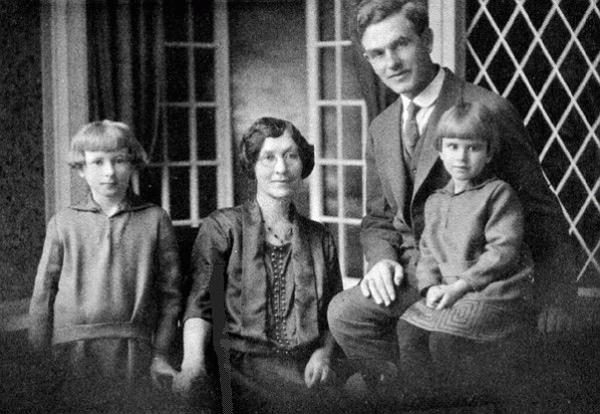 To the right is a photo of Professor Rehwinkel with his wife, Dr. Bessie Lee (Efner) Rehwinkel and their daughters Dorothy and Helen.






 Posts
Posts