6.11.2007

Who's Work is it Anyway?

In an e-mail discussion with me, Pr. M. L. F. Freiberg Sr. wrote:

When we say that God is the giver of life, that He blesses us with children through the means of procreation, how are those words being understood? Are we understanding them to mean that God is actually doing the knitting in the womb, or do we understand them to mean that he has put a process in motion that men and women make use of? If it is the latter, then NFP, for instance, may make sense to some.

That's a wise perspective on the topic. Of course God is actually doing the creating. The error we
fall into first in almost every sin is thinking that, while God started the ball rolling, we in the world are now in charge (the now "hands off" God having retreated back into His heavenly realm to watch at a distance what his creatures might do with what he has created). This is unfortunately a common worldview among Christians. I've often reminded my opponents in the contraception debate that, as with our spiritual (second) birth, the only thing we can do in procreation is reject God's gift of life. God alone creates life, spiritual and physical. Life is created through the unregenerate as well as the regenerate, and we know the unregenerate are incapable of initiating anything good. In the unregenerate, it is clear that God alone does the good work of procreating through the means of unregenerate man. Yet procreation for the Christian still must be looked at similarly from this perspective:

65] From this, then, it follows that as soon as the Holy Ghost, as has been said, through the Word and holy Sacraments, has begun in us this His work of regeneration and renewal, it is certain that through the power of the Holy Ghost we can and should cooperate, although still in great weakness. But this [that we cooperate] does not occur from our carnal natural powers, but from the new powers and gifts which the Holy Ghost has begun in us in conversion, 66] as St. Paul expressly and earnestly exhorts that as workers together with Him we receive not the grace of God in vain, 2 Cor. 6, 1. But this is to be understood in no other way than that the converted man does good to such an extent and so long as God by His Holy Spirit rules, guides, and leads him, and that as soon as God would withdraw His gracious hand from him, he could not for a moment persevere in obedience to God. But if this were understood thus [if any one would take the expression of St. Paul in this sense], that the converted man cooperates with the Holy Ghost in the manner as when two horses together draw a wagon, this could in no way be conceded without prejudice to the divine truth. (2 Cor. 6, 1: Sunergou'te" parakalou'men: We who are servants or coworkers with God beseech you who are God's husbandry and God's building, 1 Cor. 3, 9, to imitate our example, that the grace of God may not be among you in vain, 1 Cor. 15, 10, but that ye may be the temple of God, living and dwelling in you, 2 Cor. 6, 16.)

[FC, SD, Free Will]

The problem today is belief in the common erroneous sentiment the "God helps those who help themselves." NO! God does it all. He helps us because we CAN'T help ourselves. Everything we do that is of any good is entirely by the power of God, the God who HASN'T retreated to watch from afar, but rather has stayed in intimate relation with us and does not withdraw his gracious hand from all good works that we do - works which were prepared for us to do from the foundations of the world. The shame is that we so often slap his loving hands away with our flailing arms due to our misguided attempts to be in charge ourselves. Nowhere is this more obviously true than in procreation, because no other human activity is so clearly God's business than the creation of souls.
As Luther said of the divine ordinance to be fruitful and multiply:

"For this word which God speaks, 'Be fruitful and multiply,' is not a command. It is more than a command, namely, a divine ordinance [werck] which it is not our prerogative to hinder or ignore. Rather, it is just as necessary as the fact that I am a man, and more necessary than sleeping and waking, eating and drinking, and emptying the bowels and bladder. It is a nature and disposition just as innate as the organs involved in it. Therefore, just as God does not command anyone to be a man or a woman but creates them the way they have to be, so he does not command them to multiply but creates them so that they have to multiply. And wherever men try to resist this, it remains irresistible nonetheless and goes its way through fornication, adultery, and secret sins, for this is a matter of nature and not of choice."

[Luther's works, vol. 45, The Christian in Society II, The Estate of Marriage, pp. 15-21]

6.08.2007

Liberal T-Shirt

The liberal website for this shirt asks: "Tired of seeing the 'Religious Right' twisting scripture to support dividing people rather than uniting them?"

Obviously they don't even know what God meant when he said "Be fruitful and multiply!" Who's twisting Scripture for their own purposes here?

This shirt would mean something completely different than the liberals intended if my wife or I were to wear it in the company of our six children.

5.30.2007

LCMS clergy family size decrease from 1890-1920


I finally got with Dr. Carlson regarding his Touchstone article mentioning LCMS clergy family size decrease from 1890-1920. He pointed me Alan Graebner's scholarly study entitled, "Journal of Social History [vol. 2, no. 4, 1969] and, sure enough, there was the chart on the second to last page (331). I don't know why or how I forgot reading this before, and I've read the Graebner article several times in the past. This does not, after all, represent something I've never encountered before in my studies of this issue as I previously indicated in the post below. Graebner does qualify his figures relative to my questions. In the graph he identifies the figures as the "mean number of children by decennial marriage cohort," specifying even the number of children born in the first ten years of marriage. These factors eliminate my concern for the veracity of these figures in describing an increase in contraception among the LCMS clergy. The figures speak for themselves and he went to a great deal of trouble to tabulate them, as evidenced in a lengthy footnote. Thanks to Dr. Carlson for bringing up this important precipitating factor in the change in teaching within the LCMS. Very enlightening (though equally disheartening). The change in teaching obviously followed a change in personal belief and practice among the clergy. We shouldn't be surprised to see the same incipient pattern being followed toward various other false teachings today. First error seeks tolerance, then equality of footing, and finally supremacy.

5.24.2007

Another article about the "no period" pill

My Mother-in-Law sent me this article, and it has such a good quote in it that I felt I should post it too, even though Erich (I still want to call him Caspar) has beaten me to the punch.

"For women [with painful or otherwise difficult periods], I certainly can understand the benefits of taking these kinds of medications, but for most women menstruation is a normal life event -- not a medical condition," said Elson, who researches the sociology of gender and medical sociology. "Why medicate away a normal life event if we're not sure of the long-term effects?"

What other normal life events are we medicating away? Let me see here. Hmmmmmm. Oh that's right, being pregnant! How could I have forgotten that normal life event?!


Taking a pill to stop pregnancy or even your period because it is inconvenient is about the medical (and moral?) equivalent of giving my infant a pill that prevents her teeth from coming in because it's painful for her and keeps me up at night.

I hate to be so crass and angry sounding, but I can't help it. That this pill exists makes me angry. How many women are going to be four or five months pregnant and still taking this pill because they never knew they'd conceived, since there was no missed period to indicate pregnancy? How may birth defects will result? Why has medicine become a way to make life more convenient rather than a way to treat illness?

It makes me angry.

FDA Approves 'No-Period' Birth Control Pill

Lybrel, the first low-dose contraceptive pill that gives women an option to stop their menstrual cycle for an indefinite period of time. This newest form of birth control, developed by Wyeth Pharmaceuticals, contains 90 micrograms of levonorgestrel and 20 micrograms of ethinyl estradiol -- a combination similar to that found in other low-dose oral contraceptives. The difference here: Lybrel replaces the four- to seven-day placebo pill with continuous daily dosing for nonstop birth control with no menstrual periods.

Of course the media doesn't even talk about the abortifacient nature of this form of "contraception" - nor the increased risk of breast cancer and other health problems.

5.22.2007

Issues, Etc. does Contraception

Pr. Todd Wilken interviews Dr. Allan Carlson then has open lines on the subject. Click here for the MP3. The interview and beginning of the open lines segment go quite well. But then near the end of open lines the question of "how many is enough" is brought up by a caller and then Pr. Wilken makes a weak analogy regarding crop management. Then, thankfully, producer Jeff Schwarz (father of four) jumps into redeem the program, injecting the issue of trusting God into the conversation. The open lines continues for the first half of the next hour. Overall, it was a great conversation - better than previous coverage of the issue by Issues, Etc. on the subject. Pr. Wilken handled the callers' questions pretty well. I did not get a chance to call in, however. By the time I did, the program was over. I did get to say hi to Jeff, though. :-)
Dr. Carlson had an excellent article in the most recent issue of Touchstone magazine, which is what spurred this interview. Interestingly, in the article Carlson implies that the LCMS clergy began artificially limiting their family sizes between 1890 and 1920, citing a change in average family size from 6.5 to 3.7. I wonder about this implication, from which he further implies that since they thus ceased to be models of a fruitful home this contributed to the change in attitude for their congregations and the broader culture, precipitating the acceptance of contraception by the culture at large.

I'm going to contact Dr. Carlson to find out 1) the source of these figures he gave in the article, and 2) if he considered the possibility of factors other than contraception which may have contributed to this change in average family size among LCMS clergy. I would consider it possible (even probable) that during this period of substantial growth in the LCMS (especially post WWI) when so many young men were entering the ministry that the figures are more a reflection of an increased percentage of young pastors in the LCMS who had not yet fathered all their children.

If this factor is already controlled for somehow in the figures Dr. Carlson provided, then these figures represent a VERY interesting finding that I have not personally encountered thus far in my studies about this subject. In the interview (above), Dr. Carlson even broadens his comments in this regard to include the clergy of other denominations as having smaller families on average even before the official change in church teaching began to occur in 1930.

5.13.2007

Happy Mother's Day!

My old Beggarsall blogging buddy "Tim" sent me this article this morning: The Decline of Motherhood.

The author begins rightly decrying the pitiful rates of motherhood in the western world and the societal effects it is causing, but in answering her own question "How did it come to this?" she begins by emphasizing the least blameworthy factors: "In Canada, one answer is infertility. ...the two biggest factors are delayed childbearing and sexually transmitted diseases(STDs). ...Industrialized food production and environmental degradation are taking their tolls. ...hormone-treated beef. ...obesity and ovulatory cysts."

The author doesn't seem to want to identify contraception as the number-one cause of our pitiful fertility rates. However, she finally gets around to mentioning Mark Steyn's take on the problem, "...abortion, gay marriage, endlessly deferred adulthood," and then sums up:
So we pump our young with pills, wrap them in condoms and, coming soon, jab them with vaccines hoping to prevent unwanted pregnancies, STDs and, now, cervical cancer. This in the name of denying their capacity for personal responsibility by advocates who wouldn't shake hands with each other if they had a cold.

...Oh, and have an especially happy Mother's Day. Soon, there may be few mothers left to celebrate.

Motherhood is a blessed estate that blesses the world. Here is a final quote from Martin Luther commenting on 1 Timothy 2:15:

15. 'SHE WILL BE SAVED.' That subjection of women and domination of men have not been taken away, have they? No. The penalty remains. The blame passed over. The pain and tribulation of childbearing continue. Those penalties will continue until judgment. So also the dominion of men and the subjection of women continue. You must endure them. You will also be saved if you have also subjected yourselves and bear your children with pain. 'THROUGH BEARING CHILDREN.' It is a very great comfort that a woman can be saved by bearing children, etc. That is, she has an honorable and salutary status in life if she keeps busy having children. We ought to recommend this passage to them, etc. She is described as 'saved' not for freedom, for license, but for bearing and rearing children. Is she not saved by faith? He goes on and explains himself: bearing children is a wholesome responsibility, but for believers. To bear children is acceptable to God. He does not merely say that bearing children saves: he adds: if the bearing takes place in faith and love, it is a Christian work, for to the pure all things are pure (Titus 1 :15).' Also: 'All things work together,' Rom. 8:28. This is the comfort for married people in trouble: hardship and all things are salutory, for through them they are moved forward toward salvation and against adultery.... 'IN FAITH.' Paul had to add this, lest women think that they are good in the fact that they bear children. Simple childbearing does nothing, since the heathen also do this. But for Christian women their whole responsibility is salutary. So much the more salutary, then is bearing children. I add this, therefore, that they may not feel secure when they have no faith." [Luther's Works, Vol. 28, p. 279]

So, to all you Christian mothers who are submitting yourselves to God's command to be fruitful and multiply, Happy Mother's Day! May God bless you richly as he continues to bless us and the world through you!


5.09.2007

Children 'bad for planet'

Article from The Australian
By Sarah-Kate Templeton

May 07, 2007 12:00am


HAVING large families should be frowned upon as an environmental misdemeanour in the same way as frequent long-haul flights, driving a big car and failing to reuse plastic bags, says a report to be published today by a green think tank.

The paper by the Optimum Population Trust will say that if couples had two children instead of three they could cut their family's carbon dioxide output by the equivalent of 620 return flights a year between London and New York.


John Guillebaud, co-chairman of OPT and emeritus professor of family planning at University College London, said: "The effect on the planet of having one child less is an order of magnitude greater than all these other things we might do, such as switching off lights.
"The greatest thing anyone in Britain could do to help the future of the planet would be to have one less child."

Read the rest of the story
here. And the press release from OPT here.

4.26.2007

Book review: Planned Parenthood, CPH 1959

This is a book published by CPH in 1959, authored by (otherwise conservative) Professor Alfred M. Rehwinkel of Concordia Theological Seminary in St. Louis.

I just finished reading both this and the 1936 edition of For Better, Not For Worse by Walter Maier (also published by CPH). It's absolutely amazing to see the change in attitude which
occurred in the span of two decades, where CPH would then publish a book which praised Margaret Sanger and her "Planned Parenthood" clinics.

Here are some selected excerpts from this fateful volume by Prof. Rehwinkel. First, he defines the term which is the title of his
book, one which he borrowed from Margaret Sanger:

"Planned parenthood, then, means to apply to the function of begetting children and the establishment of the family the same intelligence, experience, judgment, and careful weighing of all the consequences for those concerned as a man would normally apply to any other life situation where an important decision must be made. ...That to this end they voluntarily regulate the frequency of pregnancy and set limits to the number of possible offspring by the use of artificial devices recommended for that purpose by the medical profession, governed in their decision by the exigencies of the existing circumstances." [page 9]

Remember that this is said in a positive context!


"The emerging but still groping and uncertain public opinion on birth control found an enthusiastic champion in the person of a brilliant young woman by the name of Margaret Higgens Sanger." [page 32]

He then proceeds to tell her life story and boast of her brave struggle to see the legalization of birth control.

"This state of affairs became a nightmare for the sensitive soul of Margaret Sanger. Fear of another pregnancy filled the heart of every poor woman that she came in contact with. The question that met her was always the same: 'What can I do to keep from it?' or 'What can I do to get out of it?'

"These appalling conditions haunted Margaret Sanger day and night. She appealed to the doctors to do something about it, but they refused... The struggle was a hard and a bitter one. Very few men or women had the courage to share with her the odium of public disapproval, though they might share her general ideas. She was harassed by law enforcement agencies, repeatedly suffered imprisonment, and even her husband had to go to jail for a considerable time merely for having handed to an investigator a pamphlet published by his wife on the use of contraceptives. But Margaret Sanger was determined to carry on until Anthony Comstock laws had been repealed or modified and the public opinion had been enlightened." [pages 34-35]

What a heroine!

"And it is a noteworthy fact that approximately 60% of those who answered the questionnaire prepared by Rev. Paul G. Hansen of Denver, Colo., for the Family Life Committee of the Board of Parish Education of the Lutheran Church - Missouri Synod (ca. 1953) favored a judicious practice of birth control, which seems to indicate that the position of the church is no longer convincing for a great many of its members" [page 44]

Ahhh! Theology by public opinion.

"And what complicates these difficulties still more is the fact that the Bible is not as specific in these matters as it is in other areas of Christian life. It is no wonder therefore that pious and learned theologians from the great Saint Augustine to present-day Christian scholars have wrestled with this problem and have arrived at conflicting conclusions." [page 47]

It is a wonder to me that a supposedly learned theologian such as Prof. Rehwinkel would make such an ignorant statement as this. Was he simply unaware of the unanimity of exegetical conclusions found on this issue among our fathers in the faith? One would be hard pressed to find an issue about which all previous generations have spoken with more of one voice.

"And now, if we turn to the Sacred Scriptures for a clear and definite word or directive regarding birth control, we discover to our discomfort that the Bible is surprisingly silent on the subject." [page 48]

Only because he refuses to see what all those who came
before him saw Scripture saying. Such blindness is what leads Rehwinkel to conclude that:

"...children may not always and under all circumstances be a blessing and therefore be desired by man." [page 56]

That's exactly the attitude that comes from not listening to the countless places Scripture contradicts Rehwinkel's assertion on this very point.

"Can planned parenthood or birth control as defined in Chapter II ever be considered right and permissible for Christian parents, or is it wrong and sinful in its very nature?

...The answer to the second part of the question is no." [page 88]

Then he proceeds to give unproven conclusions as to why the answer to the first part of the question is yes. Proceeding from there, he writes:

"When and under what circumstances are Christian husbands and wives free to exercise that liberty and resort to the use of contraceptives in marriage with a good conscience?" [page 92]

Now where do you think a good Lutheran theologian would direct a Christian couple for advice in such a situation of casuistry?

"Husband and wife confronted with such a decision are urged to consult a competent physician and under circumstances also a psychologist or a psychiatrist and their spiritual adviser. Attention may also be called to planned parenthood clinics found in most of the larger cities of the United States. They are staffed with a professional personnel and are ready to serve with expert advice and aid. In most cases they will be listed in the telephone directory under 'Planned Parenthood Association.'" [page 92-93]

Now, after all that HORRIBLE advice, Prof. Rehwinkel writes:

On the other hand, to fix the size of a family at the very outset, at one, two, or possibly three would be a presumptuous arrogating to themselves prerogatives that belong to God. In the first place, they must remember that they are not alone in this but copartners [sic] with God himself. It is God who creates new lives. Husbands and wives are merely the agents through whom God performs this miracle. We confess in the explanation of the First Article of the Apostles' Creed: 'I believe that God has made me and all creatures.'

In the second place, they are not even free to make such a decision. They are not absolute masters of their own lives and destinies. God may withhold all children from them.

Without this final sentence, I would have thought Rehwinkel was reversing everything he had said previously in this book. He seems on the verge of correcting himself when he says that to "
fix the size of a family at the very outset, at one, two, or possibly three would be a presumptuous arrogating to themselves prerogatives that belong to God." Since he believes Scripture does not address this, where does he get this conclusion? If limiting family size to one, two, or three, is arrogating prerogatives that belong to God, then why isn't intentionally limiting family size to five or six?

Regardless, perhaps the final sentence of this excerpt reveals
Rehwinkel's purpose in saying this. He has indicated thus far in his book that it is perfectly fine for people to limit their family size (with the exception of being voluntarily childless). Perhaps here he just wants them to realize that God may limit it even more than they intended!

On this next point, Rehwinkel shows his ignorance of the inevitable outcome of what he is promoting:

The opponents of birth control also raised this objection, that it would have disastrous consequences on the population and the economic conditions of the country.

...There is no evidence in history that birth control had an adverse effect on the economic status of a country. ...Besides, birth control is not synonymous with race suicide. It is not intended to limit families to one, two, or three children... [page 104]

If Rehwinkel could have only seen what a few decades would bring (see the figures I provided in
my earlier post below) perhaps this book would never have been written, or maybe he would have written AGAINST planned parenthood as he should have. We are now at only replacement level fertility (at best), with man and wife having on the average about two children. Our economy is also in great danger because of the aging population and the lack of young workers to support it. And it's becoming virtually impossible for Lutheran young people to find other Lutherans to marry! In his forward to Planned Parenthood, Rehwinkel writes:

"My only plea is that the reader, whoever he or she may be, follow the argumentation calmly and without prejudice to the end. If he does so, one of two things is bound to happen. Either he will be convinced that the position here presented is reasonable, sane, and in harmony with Christian ethics, or he will be confirmed more than ever before in the view that birth control in every form and under all circumstances is an evil and must therefore be opposed to the bitter end. A half-way position hardly seems possible."

Amen. But unfortunately those who read his words found it much easier to take the path of least
resistance.

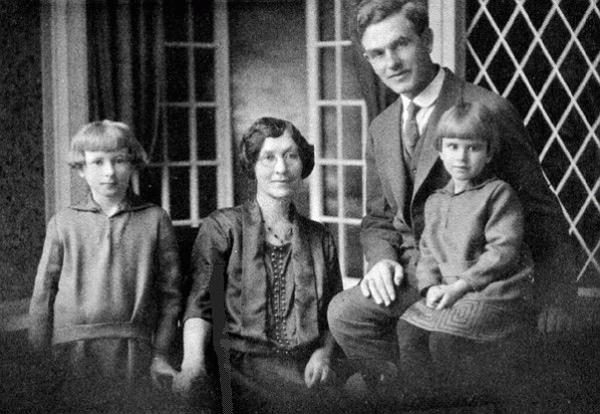
To the right is a photo of Professor Rehwinkel with his wife, Dr. Bessie Lee (Efner) Rehwinkel and their daughters Dorothy and Helen.

4.21.2007

Hormones, Cancer, and Grace

It's in the news again that women taking hormone replacement therapy are at higher risk for breast cancer. Of course most readers of L & C already knew this. But what the media almost always refuses to talk about is that the effect of hormonal birth control is known to be even greater. Used as birth control, not only do we have the same direct effect of these hormones on breast tissue, but there is the even greater carcinogenic effect of decreased procreation and breast feeding.

Delaying starting a family, and reducing the number of children one bears and nurses, may be the greatest factors in the modern epidemic of female cancers. Breast cancer was known as "nuns disease" prior to the age of family planning (about 1964 forward). Each five-year increase in a woman's age at her first full-term pregnancy raises her breast cancer risk by 7%. There is also a 7% reduction in breast cancer risk for each child a women bears to full term. And for every year of her life spent breastfeeding, a woman's risk breast cancer drops by 4.3%.

Moral of the story for young ladies: Marry early and have lots of kids! Who would have thought of it? ...uhhhh, God: "Be fruitful and multiply!" Children are a blessing in more ways than one. Just calculate the benefits my wife has gained thus far just from carrying six children to full term and nursing them all on average for 1-2 years.

I should take this opportunity to point out, however, that there is no way of achieving 100% protection against any cancer. Following God's will does not make one immune to the effects of living in a fallen world. More importantly, we must also remember that cancer is NOT a punishment for those who have not tried to follow God's will or not succeeded in the attempt.

There are temporal consequences to the way we live our lives, but Christ took ALL our punishment upon himself. Original sin brought disease, suffering, and death into this world, and it won't end until Christ comes again at the Resurrection of all flesh (come Lord Jesus, come!). But suffering is NOT a punishment from God for our personal ("actual") sins.

God has absolutely NO punishment left to offer. All our guilt was placed on Christ, 100% of the punishment was suffered by Him on the cross, and all our sins were left buried in the grave when he rose! Praise be to Christ!

4.18.2007

A Proposal For Our Lutheran Youth

The Lutheran young people of today are experiencing a crisis of sorts. For the majority of history, Christian youth were raised in families with five or more children on the average. This typically equated to a total youth population in congregations of triple the current population. It is simply a matter of fact that we have fewer young people in our midst than we did in previous decades. Birth rates are a major component in this dynamic. However, regardless of the causative factors, many churches now contend with challenges which result from much smaller youth groups.

Small numbers are particularly difficult when it comes to youth social activities. The very nature of the early years of adolescence and adulthood by necessity includes difficulty socializing with peers who do not share your interests. Only once we get married and have kids does the playing field of social interaction seem to all level out. While sin certainly plays a part in this behavior, there is also an aspect of this sociology which is simply utilitarian and natural. People gravitate toward those who share similar interests, which leads to associations which are functional and fruitful (especially those that lead to marriage!). Forcing young people with disparate temperaments to behave as close friends is no more fruitful than forcing a marriage between two people who share little in common.

There are aspects of Christian fellowship among our young people which are independent of such social similitude. Worship, joint prayer, and catechesis, are easily shared by people from all walks of life, as long as they are of the same confession. Social activities, however, cannot be limited to these universally shared activities. It is inevitable that young people will group themselves at least somewhat according to common interests. To deny this fact is to ignore an unavoidable fact of life, even though sin surely plays a part in this partial segregation. This tendency should not automatically be labeled as cliquish or antisocial behavior. It's simply a matter of practical necessity that young people seek out the company of those who share their interests and values.

What activities are necessary for our our unmarried young people, and what purposes do they serve? Why do we want them to have church-related activities outside of those which we married adults typically participate in (church work, worship, and bible study)? Well, I think we all would agree that the influence of peers affects teens more than adults. Young people are often not as firmly set in their beliefs and convictions as older adults. The unmarried typically have a great deal more time on their hands than we married adults do. And, for good or bad, that time is most often spent in the company of other young people.

What is the effect when this social activity is mostly in the presence of those who, though they share secular interests, do not share the same religious convictions? Does the company our teens keep have any influence on who they may find to be a lifelong companion in marriage? I would argue a strong affirmative. We offer little competition to the societal lures of our culture (dances, sports, extracurricular activities, etc.) and then we wonder why we are losing our youth to other churches and even unbelief.

In addition, I'd like to point out that when we segregate our youth activities too much by age, we limit the interaction of those at the fringes (such as high school seniors and college freshmen, or high schoolers and those in Junior High) who would benefit from frequent social interaction. If these social activities are to foster potential introduction of marital prospects (yes, that's a valid and important reason for these activities), we must remember that we put young ladies at a disadvantage when we segregate them into a group where they are among the oldest. Our young men also are at a disadvantage when they graduate to the next segregated age group, being the youngest of the bunch. Just ask them!

In times past, organizations such as the "Walther League" fostered positive social activity and support among young Lutherans. While these times have come and gone, such regional gatherings are possibly more needed today than ever. Why? Because congregations today often have too few young people to allow for adequate association between those who share common interests. During the baby-boom, each church had its own "Walther League" of sorts. It is probably less of an issue in larger congregations as well.

Today we see some of our youth desiring to bring their non-Lutheran friends to youth activities. Otherwise they would feel alone and without adequate social interaction in such activities. While there's not necessarily anything wrong with that, the main point I'm making here is that today's circumstances call for a different approach. To gain the numbers necessary for effective youth activities, I believe smaller congregations with an increasingly dwindling youth population must now think regionally rather than locally. While Higher Things and our Synod provide opportunities for annual national youth gatherings and one or two regional retreats, this still leaves a huge hole for the rest of the year for those seeking edifying associations for their unmarried Lutheran young people.

Today's parish youth groups think nothing of meeting at the church and then traveling a half-hour to an hour (and sometimes much more) to some activity. Why not have those from several regional churches gather at a convenient location and then share a common Bible study, fellowship, meal, and activities? This would provide our young people a greater possibility of finding those with shared interests among fellow Lutherans with whom they can enjoy the companionship of more than once yearly - or even more often than this new group I'm talking about would meet! It would foster fellowship amongst all our teens and the parents of neighboring parishes. This fellowship would approach the value which used to be enjoyed in the day when we were blessed with the presence of many young people in our congregations.

Let me jump to the chase. I have proposes to some area LCMS pastors the formation of a regional "Luther League" (or whatever you want to call it). One which I have humbly volunteered to chair. I suggest the organization of at least two formal educational youth retreats per year, and additional monthly youth gatherings for Bible study and fun activities to be shared between those of the one true faith. I propose that these activities be open to ALL unmarried young people who wish to participate, mainly between confirmation-class age and recent college graduates. Some activities would be geared toward older youth, some toward younger youth, and some of interest to all.

Some of these activities could be coordinated with "Higher Things," but having organized a youth retreat with HT last year, I can tell you from experience that doing all of what I propose under the umbrella of HT would be problematic. They have a specific well-tailored mission. They are more focused on national events and national projects, as well as "Christ on Campus" programs. They are working on developing some regional "retreats" like the one we hosted last year, and perhaps we could organize one or two of these a year for our churches. But as you can see, what I am talking about is a bit more local. I do plan on running this all past Pr. Klemet Preus and others I know at Higher Things.

The region open to taking advantage of this proposed regional organization could be limitless -- as far as someone would be willing to travel for this fellowship. Why would we exclude any Lutherans who share our confession and who wish to travel the distance for this opportunity? However, it obviously would usually work out to be more for neighboring parishes for the more frequent activities, practically speaking. We should, however, plan activities in different areas of our region -- depending on how broad the interest is.

Parents would also be welcome to chaperone and/or possibly participate in adjunct social activities planned for them. Training in proper chaperoning could be provided (I recommend this), policies and guidelines would be set, and I'd suggest that those who chaperone would be required to take advantage of this training and agree to the policies of this youth organization. The risks of bringing younger and older youth of both sexes together would be offset by a strict code of conduct and more than adequate chaperoning by qualified and dedicated parents who have been trained to do so, and who would be role models for the youth to emulate.

There were many Lutherans who met their spouses at Walther League activities. Wouldn't it be gratifying in the future to hear that people met and came to know their spouses at these regional Lutheran youth activities I suggest?

So, I throw it out to all you here on L & C as well. What do you think??? Do you have small numbers in your youth activities? I'm looking for as much input into this as possible.

Thanks,

Erich

Some Illuminating Figures

At the turn of the last century (1900) the birth rate in the Missouri Synod was around 38 per 1000 members, a natural birth rate for an industrialized country with little contraception practiced. All Christian churches and denominations taught that contraception is against God's Word.

In 1930, the Lambeth conference of Anglican bishops became very the first Judeo-Christian authority in ALL of history to deny the biblical prohibition of contraception taught in God's church since He Himself said to Adam and Eve, "Be Fruitful and Multiply," and he killed Onan for practicing it in Genesis 38:10.

From the late 1940s through the late 1950s, the birth rate in the LCMS hovered around 37 per 1000 members, not much different than a half century earlier. At this point, the Missouri Synod still held fast to the biblical teaching, vociferously condemning the acceptance of contraception by the general culture and by the Anglicans.

But in 1959, Concordia Publishing House published a book called "Planned Parenthood" by Professor Alfred Rehwinkel (an otherwise conservative theologian) of Concordia Theological Seminary in St. Louis. This book marked the beginning of the acceptance of contraception within the Missouri Synod. In the book, Rehwinkel praised Margaret Sanger's "brilliance" and "God-given talents." Sanger was the mother of birth control and remains the patron saint of abortionists (as well as eugenics, and euthanasia).

By the late 1960s, the birth rate in the Missouri Synod had dropped by a third to less than 25 per 1000 members.

In 1960, the LCMS baptized 82,000 babies.

In 1981, the LCMS Commission on Theology and Church Relations report on "Human Sexuality" (never adopted in convention) stated: "...in the absence of Scriptural prohibition, there need be no objection to contraception within a marital union which is, as a whole, fruitful." Insert whatever you like into the phrase "as a whole, fruitful" -- whatever that means outside of "childless." This CTCR report did not even attempt to refute the Scriptural prohibition of contraception taught consistently by Christians and OT Jews since the beginning of time.

While total LCMS membership has remained relatively static since 1960, the LCMS baptized only 31,700 children in 2005, a drop of 66% since 1960. We are now, like the rest of the general population, at replacement level fertility levels (about two children per family).

Currently, the casual observer sadly knows the average Lutheran family consists of one or two parents with one to three children (often with various last names). The effect of contraception obviously explains our dwindling Lutheran youth.

I thought you might find these facts illuminating.

Erich

P.S. Aaron Wolf has another good article on this in Chronicles Magazine this month (not online). I drew a couple of these figures from that article.

3.02.2007

Malcolm in the Muddle. Pt. II

This is a long string of quotes from Malcolm Muggeridge's book 'Christ and the Media'. It is longer than I like to post, but I believe it is worthy of being read, and I hope that it will generate some discussion:

Let us imagine that, somehow or other, a whole lot of contemporary pabulum – video tape and film of television programmes with accompanying news footage and advertisements, copies of newspapers and magazines, tapes of pop groups and other cacophonies, best-selling novels, a selection of successful films, recordings of political speeches, exhortations, comedies and talk shows, and other recording of the diversions, interests and entertainments of our time – gets preserved, like the Dead Sea Scrolls, in some remote salt cave. Then centuries, or maybe millennia, later, when our civilization will long since have joined the others that once were, and now can only be patiently reconstructed out of dusty ruins, incomprehensible hieroglyphics and other residuary relics, archaeologist discover the cave and set about sorting out its contents, trying to deduce from them the sort of people we were and how we lived. What, we may wonder, would the archaeologists make of us?... (pg. 53)

[They would find] on the one hand, a neurotic passion to increase consumption, promoted by every sort of fatuous persuasion among the technologically advanced people of the Western world; on the other, ever-increasing hunger and want among the rest of mankind. Never, the archaeologist will surely conclude, was any generation of men, ostensibly intent upon the pursuit of happiness and plenty, more advantageously placed to attain it, who yet, with apparent deliberation, took the opposite course, towards chaos, not order, towards breakdown, not stability, towards death, destruction and darkness, not life, creativity and light. An ascent that ran downhill… (pg. 54)

Contrasting with this apparently flourishing cult, the archaeologists would detect the vestigial traces of an earlier faith called Christianity, which had become, it seemed, largely associated with social and political causes. Thus, the prevailing Christian concept that human beings were victims of their circumstances; in the nomenclature used by some moralists, ‘situational’… (pg. 55)

Our archaeologists will have no difficulty in discovering… Liberations that enslaved, revolutions that created worse tyrannies than those they replaced, divorce reform that undermined the institution of marriage, and abortion reform that resulted in ever more abortions being performed… (pg. 56-57)

As for some mystical content in the cult of consumption, there would be no difficulty in finding that. Sex is the mysticism of materialism, a proposition that would have been born in on the archaeologists when they found themselves confronted with a superabundance of erotica of every sort and description… And then with the coming of the birth pill, the crowning glory, the achievement of unprocreative procreation, of coitus noninterruptus that is also nonfecundus, sex at last sanctified with sterility. (pg. 56)

Surveying and weighing up the whole scene, then, will not their final conclusion be that Western man decided to abolish himself, creating his own boredom out of his own affluence, his own vulnerability out of his own strength, his own impotence of his own erotomania, himself blowing the trumpet that brought the walls of his own city tumbling down, and, having convinced himself that he was too numerous, labouring with pill and scalpel and syringe to make himself fewer, until at last, having educated himself into imbecility, and polluted and drugged himself into stupefaction, he keeled over, a weary battered old Brontosaurus, and became extinct? (pg. 58)

2.14.2007

Malcolm in the Muddle


Malcolm Muggeridge - famed British journalist, one-time atheist, now hidden in Christ – wrote in his book ‘Christ and the Media’:

“… a nightmare that regularly afflicts me. I’m in the BBC studio, deep underground. Above, the mushroom clouds are forming, and the last traces of civilized life are disappearing. In the studio we are engrossed in a discussion about the alarming rise in juvenile delinquency. ‘What is needed,’ the life peeress is resonantly contending, ‘is more and better education.’ ‘If only,’ she goes on, ‘the age of consent could be lowered to nine, and the school age raised to nineteen; if only birth control pills could be distributed to Brownies with their morning milk, and sex education begin in the play school, and Lady Chatterly’s Lover get into the comics, all would yet be well.’ It is at this point that I wake up screaming, so that I never know how the discussion proceeds, and what is its outcome, if any.”

2.09.2007

The State of Our Unions

Recently, I have been doing some research on cohabitation leading to marriage. Particularly I have been looking for secular research. A colleague pointed me to 'The National Marriage Project' a "nonpartisan, nonsectarian and interdisciplinary initiative located at Rutgers, the State University of New Jersey."

Not only do they have topic specific research but they also put out a paper each year entitle 'The State of Our Unions'. Having read it, I would like to suggest that this paper is worthy of all of our consideration. The chances are that those who approach this blog either do so from a stance of agreement or disagreement. Never the less, I believe that a majority of those who approach this blog have a deep love and respect for the institution of marriage.

That being said, please consider reading this paper. No where in the paper are the words "contraceptives" or "birth control" used. I would ask the discerning reader to ask herself/himself, as she/he reads this, whether it is reasonable and/or likely that the contraceptive age has had any bearing on what they report to be 'The State of Our Unions'. And if it has had a bearing, has it been positive or negative, and to what degree?

1.30.2007

The Earth is Full?

From the Washington Post:
Myth #4: We're paving over America.

How much of the United States is developed? Twenty-five percent? Fifty? Seventy-five? How about 5.4 percent? That's the Census Bureau's figure. And even much of that is not exactly crowded: The bureau says that an area is "developed" when it has 30 or more people per square mile.

But most people do live in developed areas, so it's easy to get the impression that humans have trampled nature. One need only take a cross-country flight and look down, however, to realize that our nation is mostly open space. And there are signs that Mother Nature is gaining ground. After furious tree chopping during America's early years, forests have made a comeback. The U.S. Forest Service notes that the "total area of forests has been fairly stable since about 1920." Agricultural innovations have a lot to do with this. Farmers can raise more on less land.

Yes, American houses are getting bigger. From 1970 to 2000, the average size ballooned from 1,500 square feet to 2,260. But this hardly means we're gobbling up ever more land. U.S. homeowners are using land more efficiently. Between 1970 and 2000, the average lot size shrank from 14,000 square feet to 10,000.

In truth, housing in this country takes up less space than most people realize. If the nation were divided into four-person households and each household had an acre, everyone would fit in an area half the size of Texas. The United States is not coming anywhere close to becoming an "Asphalt Nation," to use the title of a book by Jane Holtz Kay.

1.24.2007

FDA Considering New Standards For Birth Control

The Associated Press reports:
"
In briefing documents, the FDA says newer contra-ceptives have been less effective -- at times, with twice the failure rate -- than previous products, most likely because manufacturers have started using lower doses of hormones that stop ovulation."


Preventing ovulation is only one phase of hormonal birth control. Does this mean that the other two phases are being relied upon more? Evidence presented in previous discussions here on L&C would suggest so. The third phase is abortion due to thinned uterine lining preventing implantation. If ovulation is not prevented as successfully, more abortions must occur because the [reportedly lower] doses of hormones in today's formulations are still shown to thin the uterine lining enough to prevent implantation in most cases.

In addition, "Companies often exclude women who smoke, are overweight or have a history of heart problems from their trials." This leaves us to wonder how accurate even the studies are at overall performance of hormonal "contraception."

1.14.2007

Children of Men

Click here or on the picture at the left to view the trailer for this thought provoking movie my wife and I saw last night. And here is an interview with the actors and a short consideration of the actual possibility of the total infertility theme. If you're not going to see the movie, here's a 10 minute spoiler preview. Remember, this is R-rated.

12.05.2006

No Room For Contraception

In another forum, Pastor Curtis pointed out this secular website - www.noroomforcontraception.com. While I am sure there are religious contributors to this site, it is a secular site with argumentation from the kingdom of the left. According to Pastor Curtis, you can sign up to receive their newsletter as well - something he has found profitable. Enjoy.